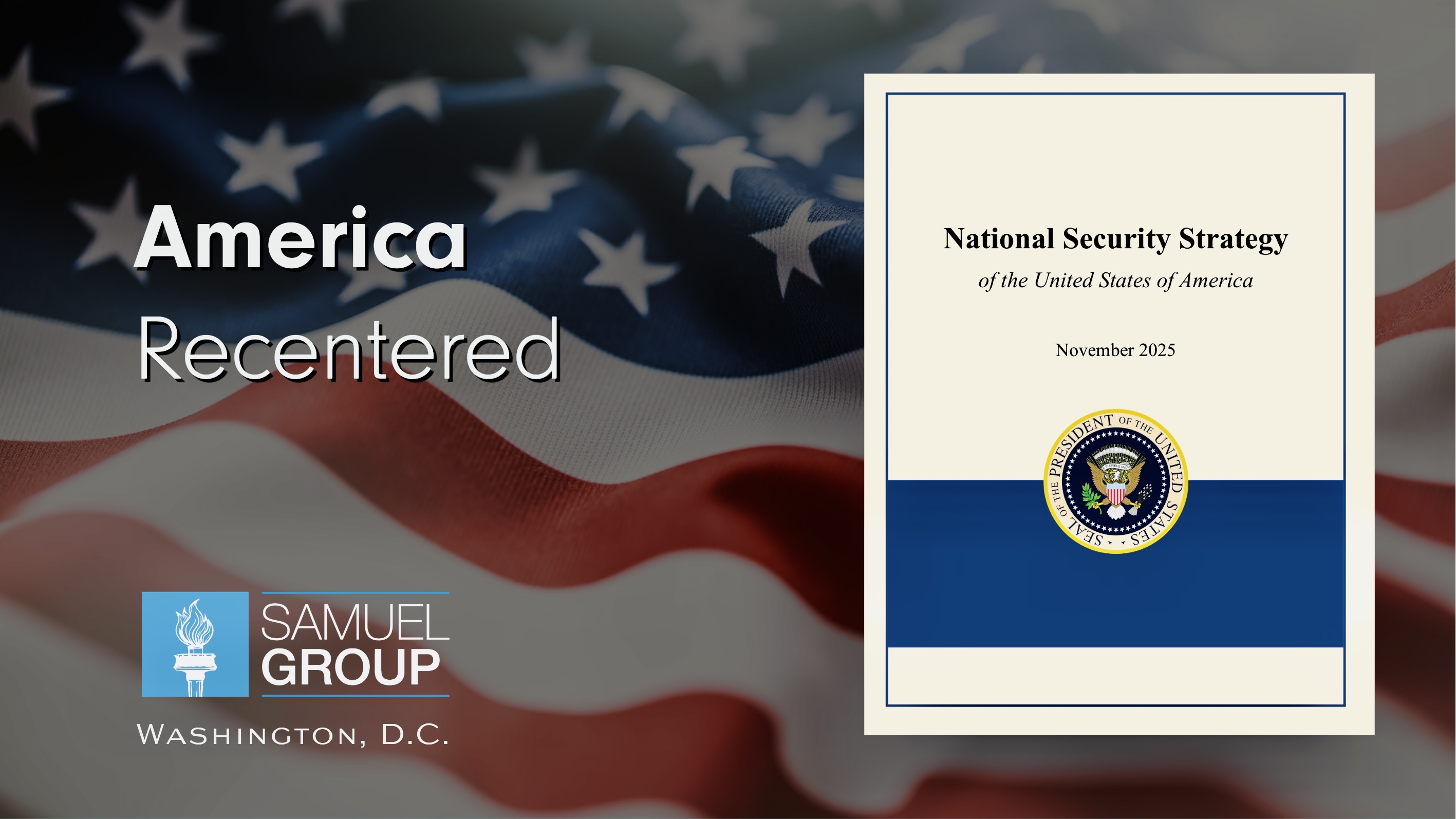
The 2025 U.S. National Security Strategy (NSS) represents the most decisive reorientation of American foreign policy in a generation. It opens with a direct repudiation of post–Cold War orthodoxy, arguing that U.S. policy elites allowed global commitments to expand far beyond America’s core interests while the domestic industrial base deteriorated (pp. 1–2).
In response, the NSS outlines a strategic framework built on sovereignty, industrial revitalization, and economic power. Rather than positioning itself as the guarantor of a global system for its own sake, the United States now emphasizes the restoration of national strength as the precondition for credible global influence.
For Samuel Group DC, this shift signals a new policy environment in Washington—one that merges industrial strategy, national security, and great-power competition into a single strategic logic that shapes how government, industry, and allies must operate.
Unlike previous NSS documents, the 2025 strategy sharply narrows the scope of what constitutes an American national interest. It rejects the inflation of global priorities and insists on disciplined focus (p. 8).
Homeland security—particularly border control—is elevated to primary national-security status. The NSS identifies border protection and the containment of illicit flows as foundational to American sovereignty (p. 11).
Economic resilience forms the second pillar: supply-chain sovereignty, industrial revitalization, and technological independence are portrayed not simply as economic goals, but as prerequisites for national power (pp. 13–14).
Alliances and partnerships are consequently reinterpreted and assessed on the basis of their material contributions to U.S. strength, rather than on shared history or values alone. For Canada, Japan, and European partners, this recalibration requires demonstrable alignment with U.S. economic, industrial, and defense priorities.
A defining feature of the NSS is its elevation of industrial and technological capacity to the center of American statecraft.
The strategy calls for a broad national mobilization to expand manufacturing output, reshore critical supply chains, and dramatically increase production of defense systems—particularly those suited to high-intensity, high-attrition environments such as drone warfare and precision munitions (p. 14).
Energy production is similarly reframed. Oil, gas, coal, and nuclear resources are depicted not only as domestic assets but as instruments of geopolitical leverage and accelerants of industrial revival (pp. 13–14).
Technological supremacy in AI, undersea warfare, autonomous systems, and space emerges as a strategic imperative, defining the next generation of military and industrial competition.
For defense firms in the United States, Japan, Canada, and Europe, this shift creates both opportunities and obligations. Integration into trusted supply chains becomes a strategic requirement, while firms that can scale production, innovate rapidly, and align with U.S. priorities will find themselves at the center of long-term procurement and cooperation frameworks.
A New Bargain for Allies
The NSS introduces a more conditional, performance-based model of alliance management.
Burden sharing is no longer rhetorical. The expectation that NATO members meet a 5 percent GDP defense-spending benchmark signals a structural overhaul of alliance obligations. Allies must demonstrate capacity—not simply commitment.
In the Indo-Pacific, expectations rise further. Treaty allies such as Japan and South Korea are urged to expand defense budgets, modernize their forces, and assume greater operational responsibility for the First Island Chain and regional deterrence architectures (pp. 24–25).
Economic policy is part of this equation. Allies are encouraged to adopt supply-chain and trade strategies that strengthen U.S. economic security.
This new alliance compact reshapes the strategic environment for Canada, Japan, and European partners. Those who align materially with U.S. objectives will be elevated within Washington’s strategic ecosystem. Those who do not risk marginalization.
The NSS reasserts U.S. primacy in the Western Hemisphere, presenting the “Trump Corollary” to the Monroe Doctrine as the guiding principle for blocking non-Hemispheric competitors from gaining footholds and reinforcing hemispheric defense and economic integration (pp. 15–19).
For Canada, this orientation opens new spaces for bilateral and trilateral defense-industrial integration with the United States.
The Indo-Pacific emerges as the focal point of U.S. strategy. The NSS acknowledges that previous assumptions regarding China—especially the belief that economic engagement would promote political moderation—have failed (pp. 19–20).
The strategy now revolves around two mandates: deterring China militarily and restructuring global supply chains to reduce Chinese leverage.
Within this context, Japan occupies a pivotal position.
Japan’s advanced industrial base, geographic proximity to Taiwan, technological leadership, and political alignment with the United States make it indispensable to the emerging Indo-Pacific security architecture. The NSS highlights the need for:
Japan’s technological and industrial capabilities—particularly in semiconductors, robotics, missile defense, and maritime security—position it as a premier partner for U.S. defense industrial cooperation.
The NSS also strengthens the Quad—the strategic grouping of the United States, Japan, India, and Australia—as a platform for orchestrating defense, technology, supply-chain, and maritime cooperation. Japan’s leadership in autonomous systems, undersea detection, and high-end manufacturing will be central to the Quad’s operational relevance.
The NSS portrays Europe as facing internal economic stagnation and political instability, yet still crucial to balancing Russia and sustaining the transatlantic industrial base (pp. 25–27). The United States seeks a Europe that is more self-reliant but still aligned with Washington’s strategic vision.
Rather than withdrawing, the United States aims to shift its Middle East strategy from crisis management to long-term economic and technological partnerships in defense, AI, and energy (pp. 27–28).
Africa is reframed as a region for investment-driven engagement, particularly in critical minerals, nuclear energy, LNG, and industrial infrastructure (p. 29).
The NSS sets the conditions for dramatically expanded demand for defense systems—especially attritable platforms, missile defense, autonomous systems, space technologies, and advanced sensors.
Industrial integration becomes a national-security requirement. Companies embedded in trusted networks—and aligned with U.S.-led supply-chain and production priorities—will gain privileged access to long-term cooperation pathways.
Japanese, Canadian, and European firms that can meet these expectations stand to benefit significantly.
Canada and Japan both face decisive strategic choices under the 2025 NSS.
Canada must scale defense spending and industrial production to remain relevant within the evolving North American defense architecture.
Japan, meanwhile, is already positioned as a central partner in the Indo-Pacific, but the NSS increases expectations for deeper defense cooperation, industrial integration, and strategic assertiveness.
All allies now face the same underlying choice: align with Washington’s material, industrial, and strategic priorities—or risk drifting to the margins of a reorganized alliance system.
Samuel Group DC is uniquely placed to help governments and industries navigate these expectations, unlock new cooperation frameworks, and integrate effectively into U.S.-led defense and supply-chain architectures.
The 2025 NSS crystallizes a new American grand strategy: one in which industrial capacity, energy abundance, technological mastery, and secure supply chains form the foundations of national power.
This is not American retrenchment; it is American recalibration. Partnerships and alliances will endure, but only for those who reinforce U.S. objectives and share in the renewed burden of collective security.
Japan already stands at the center of this strategic configuration. Canada can stand there as well—if it adapts.
For Samuel Group DC, the task ahead is clear: interpret this strategic recalibration, guide partners into alignment, and position clients at the forefront of the defense-industrial ecosystem that will define the next era of Western power.


Forging Our Future Together: The New Era of U.S.-Japan Relations.
GX, DX, and AI innovation at Deloitte Tohmatsu Innovation Park
USJC (U.S. - Japan Council) annual conference in Tokyo