For much of the post Cold War era, the Western Hemisphere occupied an ambiguous place in U.S. strategic thinking, important, but rarely urgent. That assumption is no longer tenable.
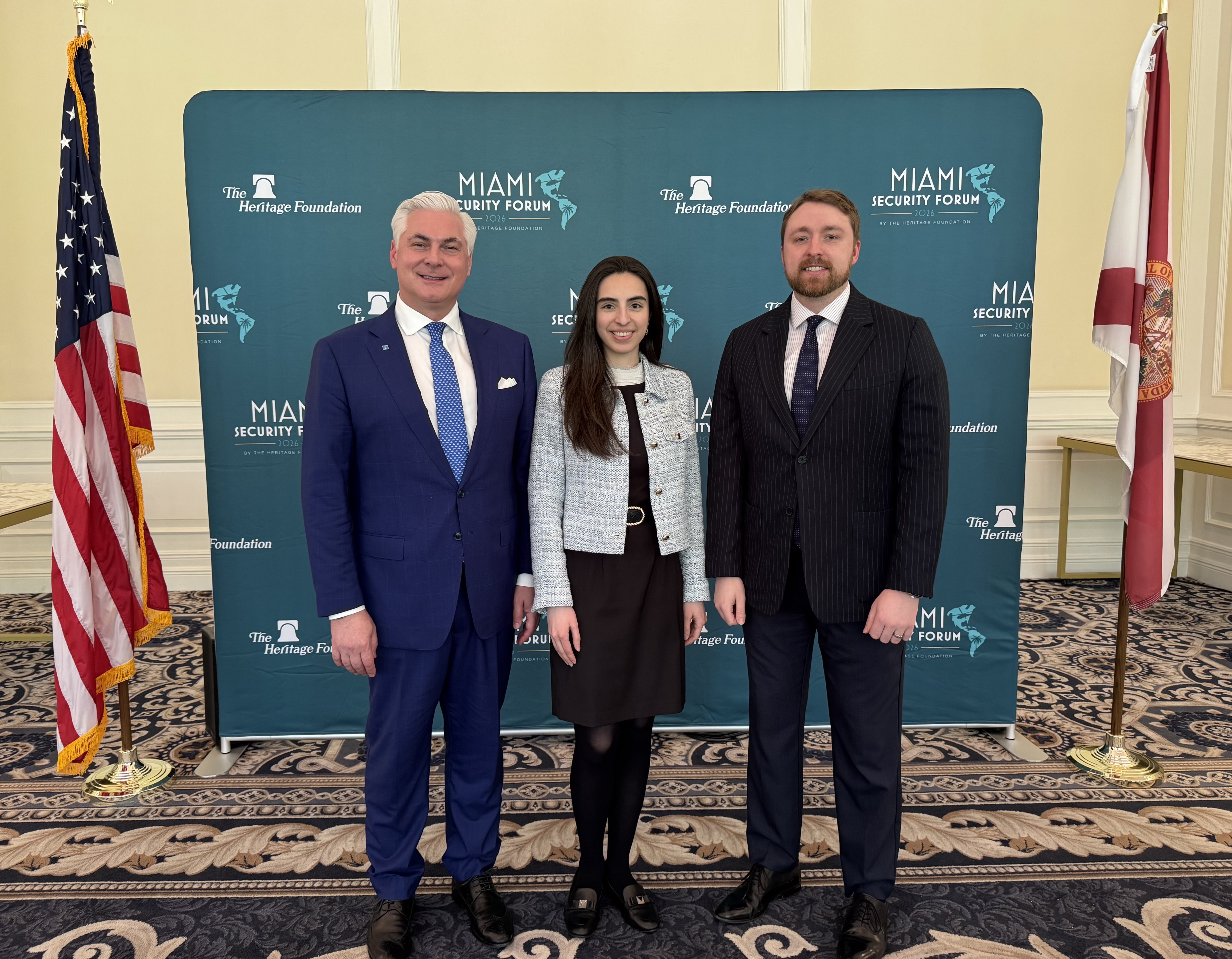
From March 18 to March 20, 2026, the Miami Security Forum, convened by The Heritage Foundation at Trump National Doral in Miami, Florida, brought together leading policymakers, national security and defense leaders, and private sector executives from across the United States and the broader Western Hemisphere. Held at full capacity, the forum reflected both the urgency and the demand for serious strategic dialogue at a moment of growing instability.
The forum was designed not simply as a conference, but as a platform to make one’s voice part of a broader conversation with leaders across the Western Hemisphere, with the objective of strengthening partnerships throughout the Americas.
Samuel Group DC had the privilege of participating in this year’s forum alongside members of our executive team, Aliénor Peyrefitte and Jonas LeBlanc Wilmink, engaging directly with senior policymakers, military leaders, and international partners.
What emerged was not simply a series of policy discussions, but a clear signal: the hemisphere is entering a new strategic phase, one defined by competition, contested governance, and the return of great power dynamics.
At the heart of the forum was a shared recognition that the Western Hemisphere faces a convergence of serious and interrelated security threats. These include narco terrorism, mass illegal migration, criminalized state structures, and the expanding influence of authoritarian and extra hemispheric powers, notably China, Iran, and Russia.
This convergence is not theoretical. It is actively reshaping the strategic environment across Central America, the Caribbean, and South America.
Three dynamics are particularly salient.
First, democratic governance is under strain. Institutional fragility, corruption, and declining public trust have created openings for both internal destabilization and external influence. These trends are not uniform, but they are sufficiently widespread to constitute a regional pattern.
Second, transnational criminal networks have evolved into hybrid actors, blurring the line between organized crime and strategic threat. Their integration into political economies, combined with their access to illicit finance and logistics, has elevated them from law enforcement challenges to national security concerns.
Third, and most consequentially, external state actors are now firmly embedded in the region. The expanding presence of China, Russia, and Iran is no longer episodic or symbolic. It is systemic. Infrastructure investment, military cooperation, information operations, and economic leverage are being deployed in ways that reshape local incentives and, over time, strategic alignment.
The forum’s keynote by Joseph Humire crystallized these dynamics with notable clarity. His remarks focused on the operational reality of strategic competition in the hemisphere, emphasizing that adversarial engagement is occurring below the threshold of conventional conflict.
This gray zone environment, characterized by influence operations, economic coercion, illicit finance, and proxy networks, poses a distinct challenge to traditional policy frameworks. It requires a level of integration across defense, intelligence, economic policy, and diplomacy that has historically been difficult to achieve.
Humire’s central argument was direct: absent a recalibrated and sustained U.S. engagement strategy, the balance of influence in key parts of the Americas will continue to shift, incrementally, but decisively, away from Washington and its allies.
If the diagnosis is increasingly clear, the policy response remains uneven. The Miami discussions suggest that the next phase of U.S. engagement in the hemisphere will need to move beyond episodic initiatives toward a more structured and strategic approach.
Several implications follow.
The Americas must be integrated into U.S. grand strategy as a primary, not secondary, domain. This requires sustained attention at the highest levels of government and alignment across agencies.
Short term engagement cycles are insufficient. What is required is long term partnership architecture, grounded in defense cooperation, economic integration, and institutional capacity building.
Infrastructure investment, supply chains, and financial systems are now instruments of strategic competition. Policy responses must reflect this reality by aligning economic tools with security objectives.
The convergence of state and non state actors necessitates enhanced intelligence coordination, legal frameworks, and operational capabilities across the region.
There is an increasing role for firms and institutions capable of operating at the intersection of government, industry, and international partners. Strategic advisory, stakeholder engagement, and policy navigation are no longer peripheral functions. They are central to execution.
One notable observation from the forum was the limited visibility of Canadian participation. At a time when North American and allied coordination are increasingly critical, this absence represents a missed opportunity.
Canada, through its defense industrial base, diplomatic networks, and Arctic and maritime expertise, has a meaningful role to play in shaping hemispheric security outcomes. Greater alignment among U.S., Canadian, and European actors would not only reinforce shared values but also enhance collective capacity in the face of systemic competition.
The Miami Security Forum 2026 did not introduce new threats. Rather, it clarified their scale, proximity, and trajectory.
The Western Hemisphere is no longer a strategic afterthought. It is an active theater of competition where governance, security, and economic influence are being contested in real time.
The policy challenge now is not one of recognition, but of execution.
For the United States and its allies, success will depend on the ability to move from fragmented engagement to integrated strategy. For industry and advisory firms, it will require the capacity to operate within this complexity, translating policy into action, and strategy into outcomes.
Samuel Group DC remains engaged in this effort, supporting clients and partners as they navigate an increasingly contested and strategically significant hemisphere.
Samuel Group DC extends its appreciation to The Heritage Foundation for convening a timely and consequential forum at a moment of strategic inflection.


Forging Our Future Together: The New Era of U.S.-Japan Relations.
GX, DX, and AI innovation at Deloitte Tohmatsu Innovation Park
USJC (U.S. - Japan Council) annual conference in Tokyo