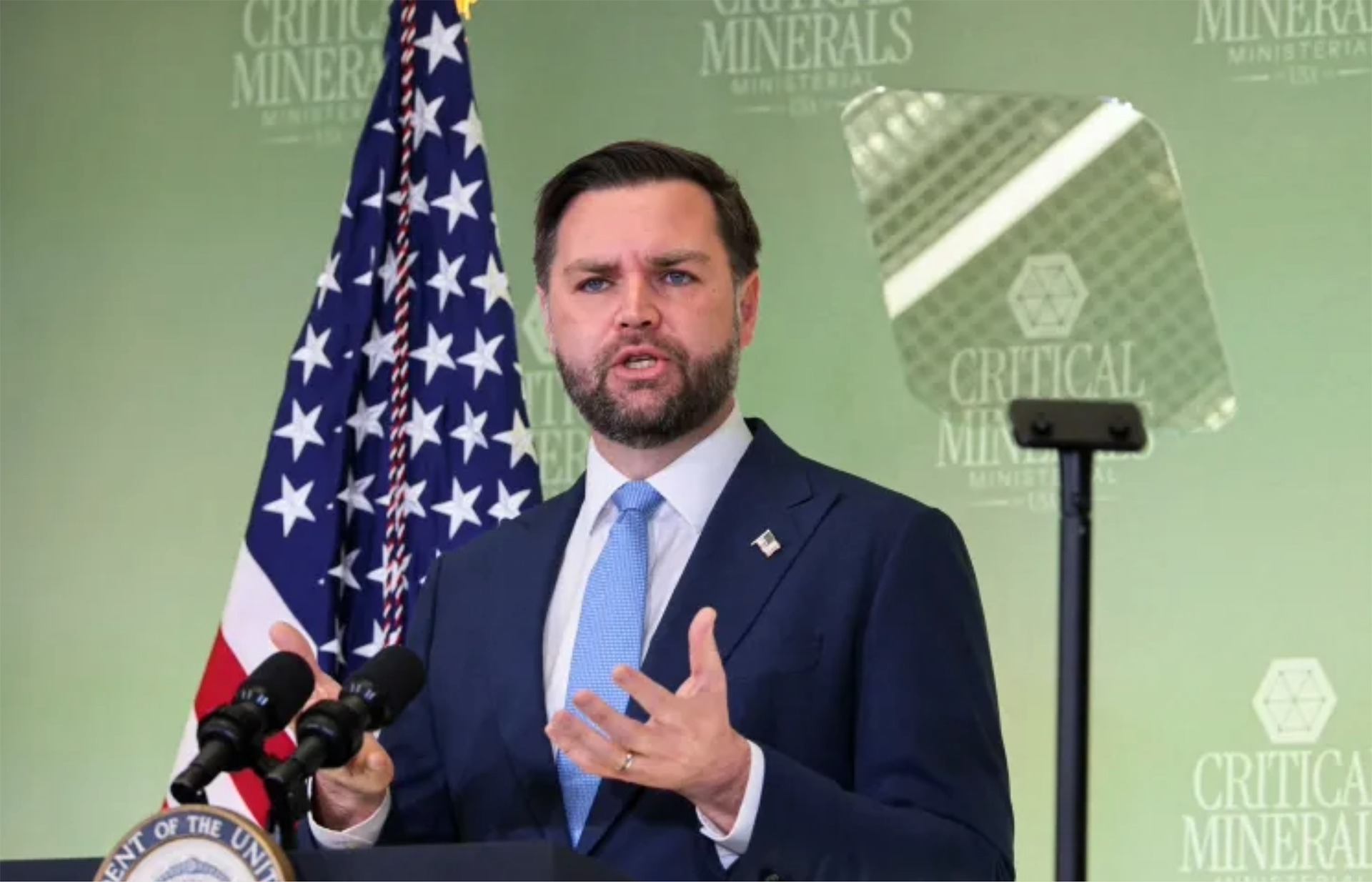
On February 4, 2026, Washington hosted what it framed as a once-in-a-generation effort to reorganize the global market for critical minerals and rare earths—materials embedded in everything from precision-guided munitions and radar systems to satellites, batteries, and the AI hardware underpinning modern command-and-control. The Vice President of the United States, the Secretary of State, and a full bench of economic and energy officials used the occasion to launch a new diplomatic architecture for minerals—and to signal something more consequential: in this era, supply chains are no longer treated merely as trade flows, but as strategic terrain.
This shift matters for the Department of War—and for every defense industrial base tied to the United States—because the limiting factor is no longer design sophistication or factory throughput alone. It is the assured availability of inputs, processed to specification, delivered on time, and insulated from coercion, across end-to-end supply chains that remain highly concentrated. The “market” itself is being redesigned as an instrument of national power.
Reporting from the ministerial makes clear that the United States is moving toward a preferential critical-minerals trading network with partners and allies, including coordinated tools such as price floors—an explicit departure from a purely market-driven posture and toward managed resilience. This is not simply about extracting more ore. It is about reshaping incentives: stabilizing investment conditions, deterring predatory pricing, and reducing dependence on processing choke points.Two implications follow directly for defense readiness:
Mineral deposits are geographically widespread; processing capacity—chemical conversion, separation, metallurgy, and specification-grade manufacturing—is not. Strategies that emphasize upstream extraction alone risk recreating vulnerability in a different jurisdiction.
When access to essential inputs is governed by club rules, industrial participation increasingly mirrors strategic alignment. Defense supply chains will follow the contours of these emerging arrangements.
The most tangible expression of Washington’s new posture is Project Vault, a U.S. critical-minerals reserve designed to buffer supply shocks and sustain domestic manufacturing. Structured around unprecedented Export-Import Bank financing and private capital, Vault reflects a deliberate revival of strategic stockpiling—reimagined not for battlefield consumption, but for industrial continuity.
For the Department of War, this marks a doctrinal shift. Deterrence in the 21st century depends not only on what is fielded today, but on the ability to replenish, surge, and adapt production under conditions of stress. Strategic reserves now serve the factory floor as much as the armory.
The ministerial also introduced FORGE, the Forum on Resource Geostrategic Engagement, as the successor to earlier coordination efforts. Where previous frameworks emphasized principles and alignment, FORGE is designed to be operational and project-driven.
This distinction matters. The next phase of minerals diplomacy will be judged not by communiqués, but by bankable pipelines—projects that can clear permitting, financing, offtake, ESG scrutiny, and geopolitical risk in time to be strategically relevant.Here, the Department of War’s role becomes decisive. Defense demand does not merely purchase minerals; it anchors markets through long-term contracting, qualification standards, and—often quietly—by redefining acceptable risk in the name of national security.
The implications for clients operating in, adjacent to, or seeking entry into the U.S. defense and national security ecosystem are clear.
Critical minerals are being treated as foundational national capabilities—alongside shipbuilding, microelectronics fabrication, and aerospace manufacturing. Expect minerals policy to be increasingly integrated with defense acquisition, readiness planning, and allied industrial cooperation.
The scale and speed of U.S.-backed financing, spanning stockpiles, domestic projects, and partner-country initiatives, will separate projects that align with U.S. security priorities from those that do not. Access to capital is rapidly becoming a proxy for strategic alignment.
Canada remains a trusted partner with significant resource depth and industrial compatibility. Yet the emerging framework rewards those who can move quickly from geology to qualified supply—processing, specification, traceability, and secure logistics. The window is open now, not later.
Expect stricter requirements around chain-of-custody, ownership structures, technology transfer, and facility security—particularly where projects touch sensitive alloys, magnets, battery precursors, or defense-adjacent electronics. Governance will need to be designed in from the outset.
Mining will continue to attract headlines, but the strategic contest lies in refining, separation, precursor chemicals, advanced metallurgy, recycling, and reprocessing. Any serious critical-minerals strategy tied to defense must be built around midstream capability.
For firms navigating this landscape, several imperatives stand out:
In 2026, critical minerals are no longer a background issue in defense planning. They are part of the arsenal itself: quiet, industrial and decisive.


Forging Our Future Together: The New Era of U.S.-Japan Relations.
GX, DX, and AI innovation at Deloitte Tohmatsu Innovation Park
USJC (U.S. - Japan Council) annual conference in Tokyo