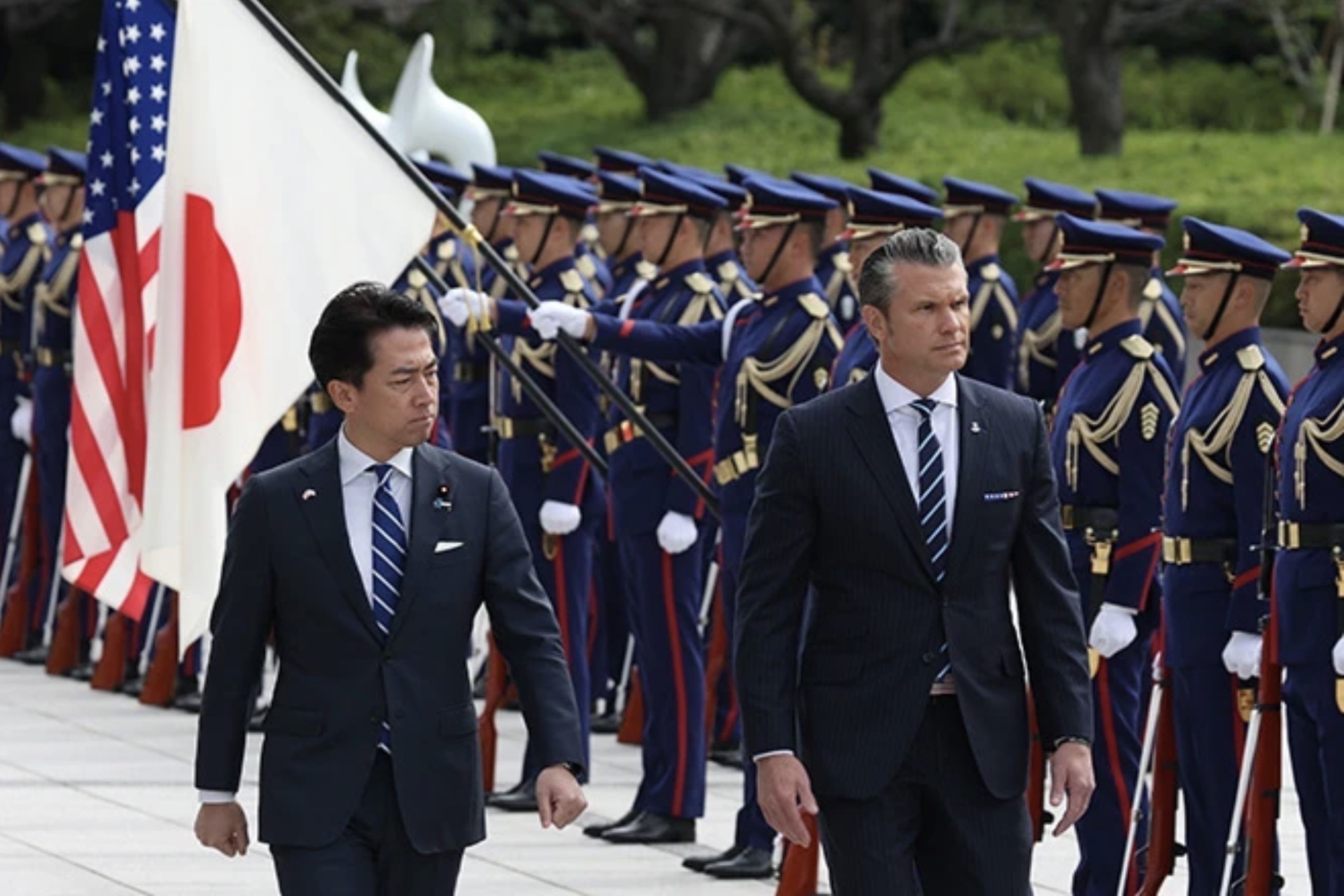
Japan’s FY2027 defense budget request should be understood as considerably more than another increase in military spending, because it reflects a broader transformation in how Tokyo intends to defend the country, strengthen its national defense industrial base, and contribute to collective security alongside the United States and other allies and partners across the Indo-Pacific.
With approximately ¥9 trillion or US$56 billion requested for FY2027, Japan is continuing the substantial defense modernization effort that has accelerated in recent years, directing investment toward unmanned and autonomous systems, artificial intelligence, integrated air and missile defense, long-range precision strike, space, cyber, resilient command and control, logistics, munitions, and military infrastructure. While the scale of this investment is significant, the more consequential development for Washington may be the industrial strategy emerging alongside these capability investments and the opportunities it creates for deeper cooperation between the Japanese and American defense industrial bases.
One of the clearest messages emerging from Japan’s defense planning is the recognition that military capability cannot be separated from the industrial capacity required to manufacture, maintain, sustain, and replenish it. Japan’s Ministry of Defense is placing increasing emphasis on strengthening the country’s defense production and technology base through investments in manufacturing capacity, innovation, advanced technologies, and greater international defense equipment cooperation.
The experience of recent conflicts has reinforced a lesson that governments across Europe, North America, and the Indo-Pacific are increasingly incorporating into their national security strategies: sophisticated weapons systems alone cannot provide credible deterrence if the industrial infrastructure required to produce ammunition, repair equipment, replace losses, and sustain military operations cannot respond at sufficient speed and scale.
For Japan, this represents an important evolution from a defense industrial model that has historically concentrated on supplying the Japan Self-Defense Forces toward one that is becoming more internationally connected through technology partnerships, allied supply chains, defense equipment transfers, and potentially greater opportunities for co-development and co-production with trusted partners.
For decades, the U.S.-Japan alliance has rested on American extended deterrence, the presence of U.S. forces in Japan, and the increasingly capable Japan Self-Defense Forces, but the changing strategic environment suggests that the next phase of the alliance will need to include a much deeper industrial dimension.
The United States faces substantial requirements for additional munitions, missiles, shipbuilding capacity, aerospace production, maintenance and sustainment, autonomous systems, advanced electronics, and resilient supply chains, while Japan possesses considerable strengths in advanced manufacturing, robotics, electronics, aerospace, shipbuilding, sensors, advanced materials, and precision engineering. Connecting these complementary capabilities could strengthen not only the bilateral alliance but also the broader industrial architecture required to sustain deterrence throughout the Indo-Pacific.
The strategic discussion between Washington and Tokyo should therefore increasingly move beyond questions concerning which military capabilities Japan should acquire and toward a broader examination of what the two countries can develop, manufacture, sustain, and potentially export together.
Japan’s FY2027 priorities also illustrate how rapidly emerging technologies are changing the character of military operations, particularly through the increasing importance of autonomous systems, artificial intelligence, space capabilities, advanced sensors, and integrated command-and-control architectures.
Unmanned capabilities feature prominently across the air, maritime, and land domains, including intelligence, surveillance, and reconnaissance platforms, attack systems, unmanned underwater capabilities, and autonomous logistics. At the same time, artificial intelligence is increasingly being incorporated into command-and-control and decision-support systems, while investments in integrated air and missile defense, longer-range precision strike, space-based surveillance, missile detection, resilient communications, and cyber capabilities are creating a more interconnected military architecture.
These technologies are developing rapidly and often require substantial investment in research, specialized manufacturing, and supporting digital infrastructure, making it increasingly difficult for even advanced allied countries to develop every capability independently. Greater cooperation among Japanese and American defense companies, technology firms, research institutions, and governments could therefore accelerate innovation while distributing development costs, expanding production capacity, and strengthening interoperability.
The geography of the Indo-Pacific makes industrial resilience particularly important because any major regional contingency would involve enormous distances, vulnerable transportation networks, and sustained requirements for ammunition, fuel, maintenance, transportation, infrastructure, and replacement equipment.
Japan’s FY2027 priorities recognize this challenge by placing considerable emphasis not only on sophisticated weapons and emerging technologies but also on ammunition stocks, logistics, transportation, medical support, infrastructure, and operational resilience. This reflects an understanding that credible deterrence ultimately depends on demonstrating that military forces can continue operating beyond the initial stages of a crisis and that national and allied industrial bases can sustain those operations over time.
Strengthening defense production, maintenance capacity, and supply chain resilience should consequently become an increasingly important component of U.S.-Japan defense cooperation, particularly as both countries consider the requirements associated with prolonged operations across the Western Pacific.
The emerging environment presents substantial opportunities for deeper cooperation across a range of sectors, including co-production and licensed production of defense equipment, missile and munitions supply chains, maintenance, repair, and overhaul, aerospace and propulsion, autonomous systems, artificial intelligence and C4ISR, sensors and advanced electronics, space technologies, secure communications, shipbuilding, maritime systems, advanced materials, and manufacturing.
Japanese companies should increasingly consider the United States not simply as an export destination but as a location for long-term industrial partnerships, investment, manufacturing, technology development, and participation in American defense supply chains. American companies, similarly, have an opportunity to view Japan not simply as an important customer but as a sophisticated source of technology, manufacturing expertise, and industrial capacity that could contribute directly to U.S. and allied defense requirements.
Such relationships would represent a significant evolution from traditional defense trade toward a more integrated model in which allied industrial capabilities become part of a shared deterrence architecture.
Canada should also have a place within this emerging industrial relationship because the Canadian and American defense industrial bases are deeply interconnected, and both countries are placing greater emphasis on strengthening domestic and allied production capacity in aerospace, space, autonomous systems, sensors, critical technologies, munitions, and advanced manufacturing.
For Japanese companies considering expansion into North America, there may therefore be considerable value in approaching Canada and the United States as complementary components of a broader continental defense market rather than treating them as entirely separate opportunities. Partnerships combining Japanese technology and manufacturing expertise with American scale, Canadian industrial capabilities, and established North American supply chains could become increasingly attractive as allied governments seek greater production capacity and reduced dependence on vulnerable sources of critical technologies and components.
This environment also creates opportunities for North American companies seeking access to Japanese technology, manufacturing partnerships, and Japan’s expanding defense market, particularly where complementary capabilities can contribute to shared security requirements across the Indo-Pacific and North America.
Japan’s FY2027 defense plans are ultimately part of a much larger transformation occurring across allied capitals in which defense policy, industrial policy, and technology policy are becoming increasingly interconnected. Governments are recognizing that deterrence requires not only capable armed forces but also the industrial infrastructure, skilled workforce, technology base, production capacity, and secure supply chains necessary to sustain those forces during periods of prolonged geopolitical competition or conflict.
For Washington and Tokyo, the opportunity is therefore to translate one of the world’s most consequential military alliances into an equally consequential defense industrial partnership by expanding cooperation beyond traditional buyer-seller relationships toward co-development, co-production, industrial investment, technology partnerships, and more integrated supply chains.
If successfully developed, this approach could strengthen the defense industrial bases of both countries while creating additional capacity across the broader network of U.S. allies and partners. It could also provide Japanese and American companies with new opportunities to collaborate in areas where technological specialization, manufacturing scale, and complementary industrial capabilities can produce outcomes that neither country could achieve as efficiently on its own.
Japan’s defense transformation should therefore command attention well beyond Tokyo, because the decisions being made today concerning production capacity, emerging technologies, and international industrial cooperation could help define the next phase of the U.S.-Japan alliance and shape the wider architecture of allied defense production across the Indo-Pacific and North America.
Samuel Group D.C. provides strategic advisory services at the intersection of defense, national security, government and industry in Washington, D.C., supporting companies and organizations navigating the evolving relationship among allied security priorities, defense procurement, and industrial cooperation.


Forging Our Future Together: The New Era of U.S.-Japan Relations.
GX, DX, and AI innovation at Deloitte Tohmatsu Innovation Park
USJC (U.S. - Japan Council) annual conference in Tokyo