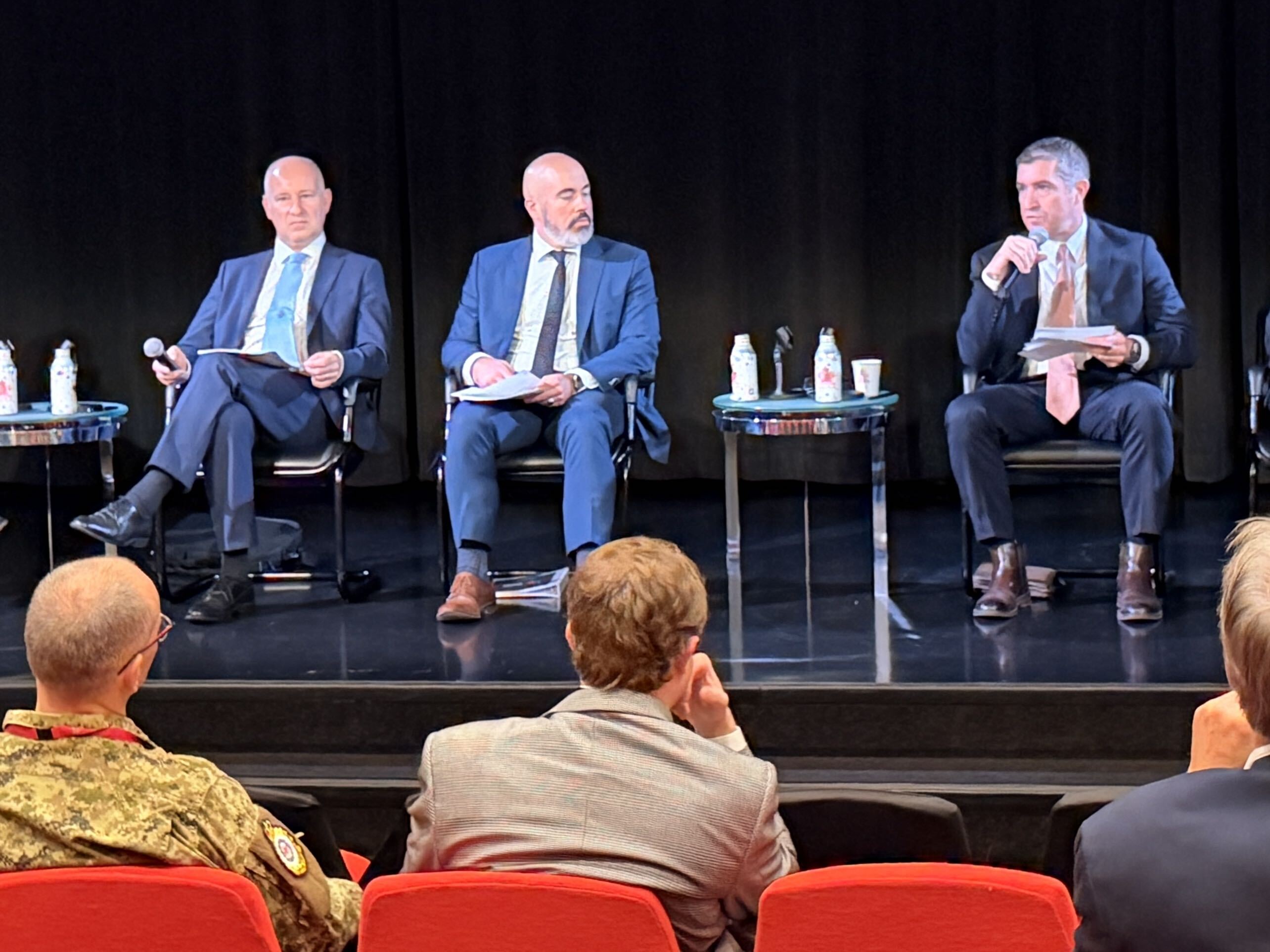
On October 14, 2026, Goran Samuel Pesic, President and CEO of the Samuel Group of Companies, attended Sovereign Capacity, Shared Readiness: Procurement, Production and Resilience Across the Five Eyes at the Embassy of Canada in Washington, D.C. Held during the Association of the United States Army (AUSA) annual meeting, the discussion examined how trusted partners can strengthen their defense industrial bases and deliver military capability more quickly.
The Five Eyes partners, Australia, Canada, New Zealand, the United Kingdom, and the United States, face a challenge that extends beyond acquiring equipment. Military readiness also depends on reliable access to production, repair capacity, critical materials, and skilled workers. Cooperation must address how these resources will remain available when demand rises or supply is disrupted.
At Samuel Group D.C., our assessment is that a more coordinated industrial framework is achievable through selected joint programs and dependable reciprocal arrangements. The discussion revealed considerable agreement on the need for reform, while leaving important questions about national priorities, industrial participation, and crisis access unresolved.
A central theme was the connection between industrial capacity and the ability to sustain military operations. Equipment already in service must be supported by replacement parts, munitions, maintenance, and the capacity to regenerate losses. Higher procurement spending can help, but industrial readiness ultimately depends on what factories and supply networks can deliver.
There was broad support for faster procurement, simpler contracting, and closer engagement between operational users and industry. These changes are particularly relevant to autonomous and digital systems that evolve quickly. Reform must give officials the authority to make timely decisions and establish who accepts the associated risk.
The discussion also emphasized smaller companies, technology suppliers, and new sources of investment. Their contribution will depend on access to repeat orders and a viable path to production scale. Governments need to turn interest in innovation into commercial opportunities that firms can sustain.
The main tension concerns the relationship between national industrial ambitions and collective efficiency. Governments want domestic capability, skilled employment, and dependable access to essential equipment. They also recognize the advantages of combining demand and drawing on partners’ strengths.
These objectives can reinforce each other when investments add useful production capacity or alternative sources of supply. They can become harder to reconcile if several countries build competing facilities without enough orders to sustain them, or if specialization leaves a partner dependent on capacity it cannot reliably access.
Our view is that cooperation needs an explicit account of what each participant contributes and receives. Agreements should address industrial participation, technical information, sustainment rights, and access during shortages. These are practical conditions for governments to place confidence in shared production.
The strongest prospect is a framework that coordinates national systems around defined requirements. Partners could combine orders, align essential specifications, and establish reciprocal production or sustainment arrangements. Participation could vary by program, reflecting operational needs and industrial strengths.
Credible demand is essential. An announced spending plan provides less certainty than a funded order. Companies considering new facilities or workforce expansion need commitments over several years that justify the investment. Pooling requirements can make those commitments more valuable, particularly where a national market alone is too small to sustain production.
Partners would also need compatible approaches to testing, certification, and commercial risk. Faster national acquisition will have limited collective value if equipment faces repeated acceptance processes across borders. Recognizing appropriate assurance work undertaken by a partner could reduce delay while preserving necessary safety and performance standards.
A unified framework should also remain open to other allies and partners with relevant capabilities. The value of cooperation depends on the operational result and reliability of supply. Requiring identical participation in every project would limit opportunities to use complementary strengths.
A useful next step would be a limited pilot addressing a documented operational need. It should bring together funded demand, clear delivery responsibilities, and agreed access to production or sustainment. Performance could be measured through delivery times, output against schedule, repair turnaround, and the availability of alternatives during disruption.
The decisive test is whether an arrangement works when several partners need the same scarce supply at once. Governments should understand how output would be allocated and what their forces could count on. Testing those arrangements before a crisis would provide stronger evidence of readiness than an announcement of cooperation alone.
For Samuel Group D.C., the discussion reinforces the value of practical U.S. and allied defense industrial cooperation. The Five Eyes have a credible foundation for closer coordination. The next step is to translate that alignment into a manageable set of shared commitments that produce additional capacity and dependable support for military operations.
The discussion was held under the Chatham House Rule. This article presents Samuel Group D.C.’s analysis without attributing remarks to individual participants or national delegations.


Forging Our Future Together: The New Era of U.S.-Japan Relations.
GX, DX, and AI innovation at Deloitte Tohmatsu Innovation Park
USJC (U.S. - Japan Council) annual conference in Tokyo