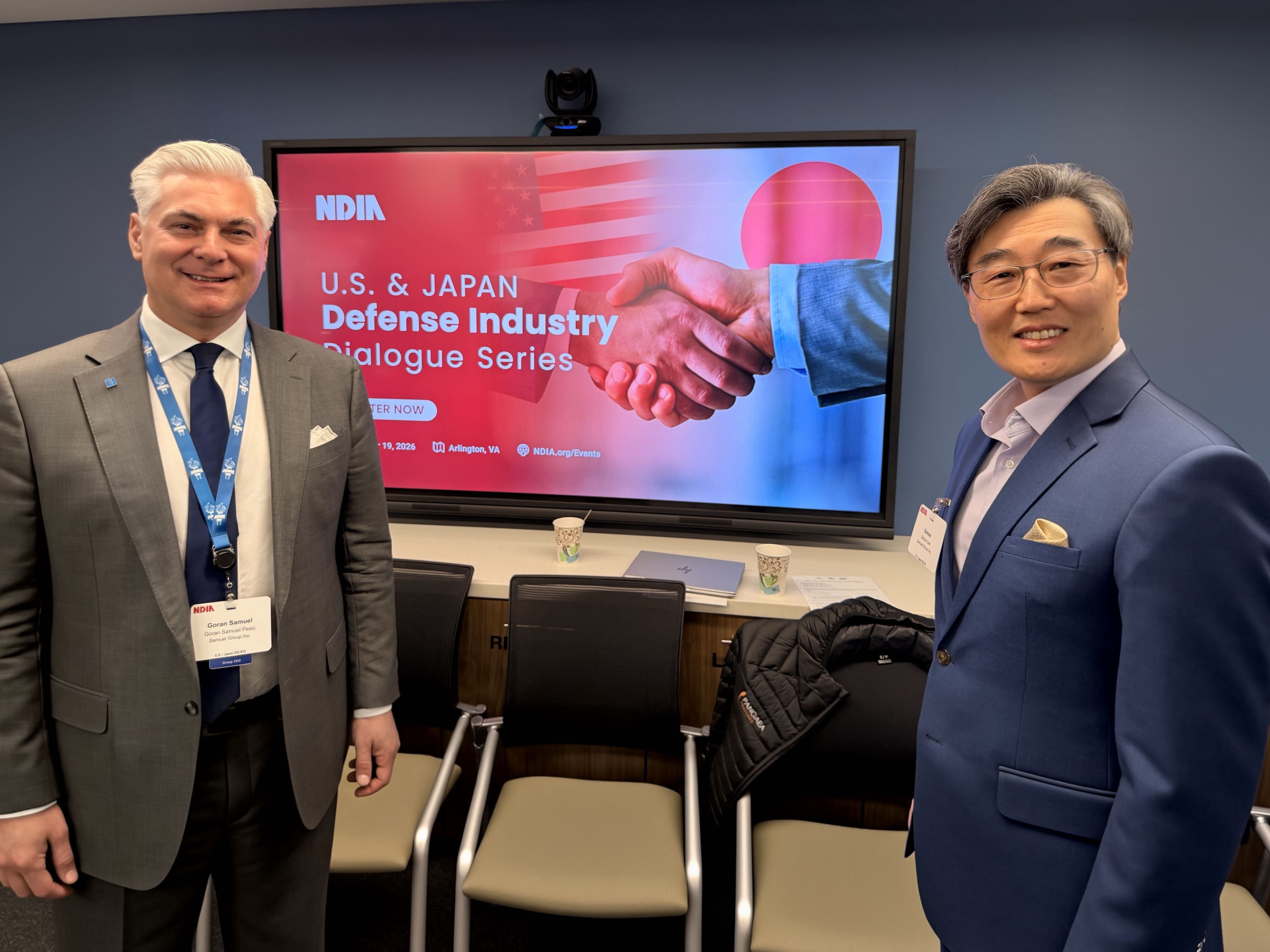
Samuel Group D.C. participated in a timely discussion on U.S.–Japan defense industrial cooperation at the 19th Defense Industry Dialogue, held November 19 at NDIA headquarters in Arlington, Virginia. Convened by the National Defense Industrial Association (NDIA), the Society of Japanese Aerospace Companies (SJAC), and the Japan Association of Defense Industry (JADI), the event addressed government policies and initiatives shaping bilateral industrial cooperation.
For defense businesses, the significance lies in the work needed to turn stronger political commitments into additional production and dependable support for military equipment. Samuel Group D.C.’s assessment is that companies able to address a defined manufacturing bottleneck, component requirement, or maintenance need will have a stronger basis for pursuing business than those relying on general expectations of market growth.
The public policy context is increasingly practical. Japan and the United States upgraded their Defense Industrial Cooperation, Acquisition, and Sustainment framework to DICAS 2.0 in April 2026. Its work spans missile co-production, aircraft and ship sustainment, and supply-chain resilience.
The strategic logic is straightforward. Military capability depends on how reliably industry can supply equipment and return it to service. Cooperation can strengthen that capacity when partners contribute complementary facilities, skills, or sources of supply. Its value must ultimately be demonstrated through output and equipment availability.
For industry, this makes delivery performance central to the business case. A company’s ability to shorten a repair cycle or increase reliable component output can be directly relevant to an alliance requirement.
On October 28, the two governments agreed to establish an Advanced Medium-Range Air-to-Air Missile (AMRAAM) final assembly and checkout facility in Japan. They also agreed to share technical information needed to increase SM-3 Block IIA production.
These commitments point toward identifiable industrial work. Depending on the eventual contracting arrangements, opportunities could extend to electronics, precision manufacturing, testing equipment, and production support. Smaller suppliers should examine where their capabilities fit within the requirements of an authorized prime contractor or program partner.
The commercial opportunity develops in stages. An agreement to establish a facility must be followed by decisions on investment, contracting, qualification, and delivery. Businesses should match their spending to those milestones and the demand they can substantiate.
Aircraft sustainment provides another avenue for U.S.–Japan cooperation, with IHI Corporation’s expertise in aircraft engine manufacturing and maintenance offering opportunities for deeper industrial collaboration. Under DICAS, the two governments are pursuing F100 component manufacturing and F110 component repair as pilot cases toward U.S. Air Force approval through the Source Approval Request process. Complementary work under the Partnership for Indo-Pacific Industrial Resilience (PIPIR) is examining the feasibility of an F100/F110 engine repair hub in Japan. Together, these initiatives could create opportunities for IHI to expand its contribution to regional engine sustainment, strengthen supply chains, and support allied operational readiness.
Ship repair has already produced a concrete example. Japan’s Ministry of Defense reports that USS Fitzgerald underwent repairs in Maizuru in December 2025, marking the first such work by a Japanese company on a U.S. naval vessel homeported in the American mainland.
In our assessment, sustainment can offer a practical entry point for companies with relevant technical experience. A tightly defined repair or component package can establish a performance record and support a broader partnership. The business case should account for access to technical data, tooling, qualified personnel, and the approvals required for the specific work.
Japan revised its defense equipment transfer principles and implementing guidelines on April 21, 2026. The policy links transfers to the security of Japan and its partners while retaining individual examination and appropriate controls.
In Washington, the State Department’s November 17 announcement on reform of the International Traffic in Arms Regulations (ITAR) also signals an effort to make defense trade more efficient. The commercial effect will depend on which measures take effect and the transactions they cover.
For Japanese companies, partnerships with American firms may help connect specialized capabilities to established customer relationships and support networks. For American businesses, Japanese partners may offer additional production capacity and regional sustainment options. Those benefits depend on clear work allocation and a viable arrangement for sharing the necessary technology.
Companies considering sales to other allied markets should examine each proposed transaction on its own terms. A bilateral partnership provides a commercial platform; the destination, equipment, and applicable authorizations determine what business it can support.
The first task is to identify a specific customer requirement and the route through which it could be funded and contracted. A broad government announcement is useful evidence of policy direction. A business opportunity becomes more credible when a company can identify the buyer, the required capability, and the next acquisition decision.
The second task is to select partners for the role they can actually perform. A useful partnership should establish who owns the customer relationship, who holds the relevant technical rights, and who will perform and support the work. Those decisions shape the investment needed and the revenue each company can reasonably pursue.
Companies should also prepare the evidence that makes their offer assessable: demonstrated capacity, achievable lead times, quality performance, and a clear plan for qualification. Proposals should explain how the work improves production or equipment availability, with assumptions that the customer can test.
Investment should then follow the maturity of the opportunity. A defined pilot or initial work package can help establish performance before a company commits to larger facilities or additional staffing. Boards and management teams should distinguish policy support, technical approval, and funded demand when assessing expected returns.
The dialogue was timely because U.S.–Japan industrial cooperation is generating projects against which progress can be measured. The next commercial decisions concern who will carry out the work, under which approvals, and with what delivery commitments.
For Samuel Group D.C., the business implication is clear. Companies should connect their capabilities to a defined requirement and build the partnerships needed to deliver it. The strongest proposals will show how a specific contribution increases dependable industrial capacity while offering a sustainable commercial return.
This article presents Samuel Group D.C.’s independent analysis on a non-attributable basis, consistent with the Chatham House Rule. No remarks are attributed to individual participants.


Forging Our Future Together: The New Era of U.S.-Japan Relations.
GX, DX, and AI innovation at Deloitte Tohmatsu Innovation Park
USJC (U.S. - Japan Council) annual conference in Tokyo